
Compostable vs. Recyclable Packaging: What’s Actually Better for NZ?
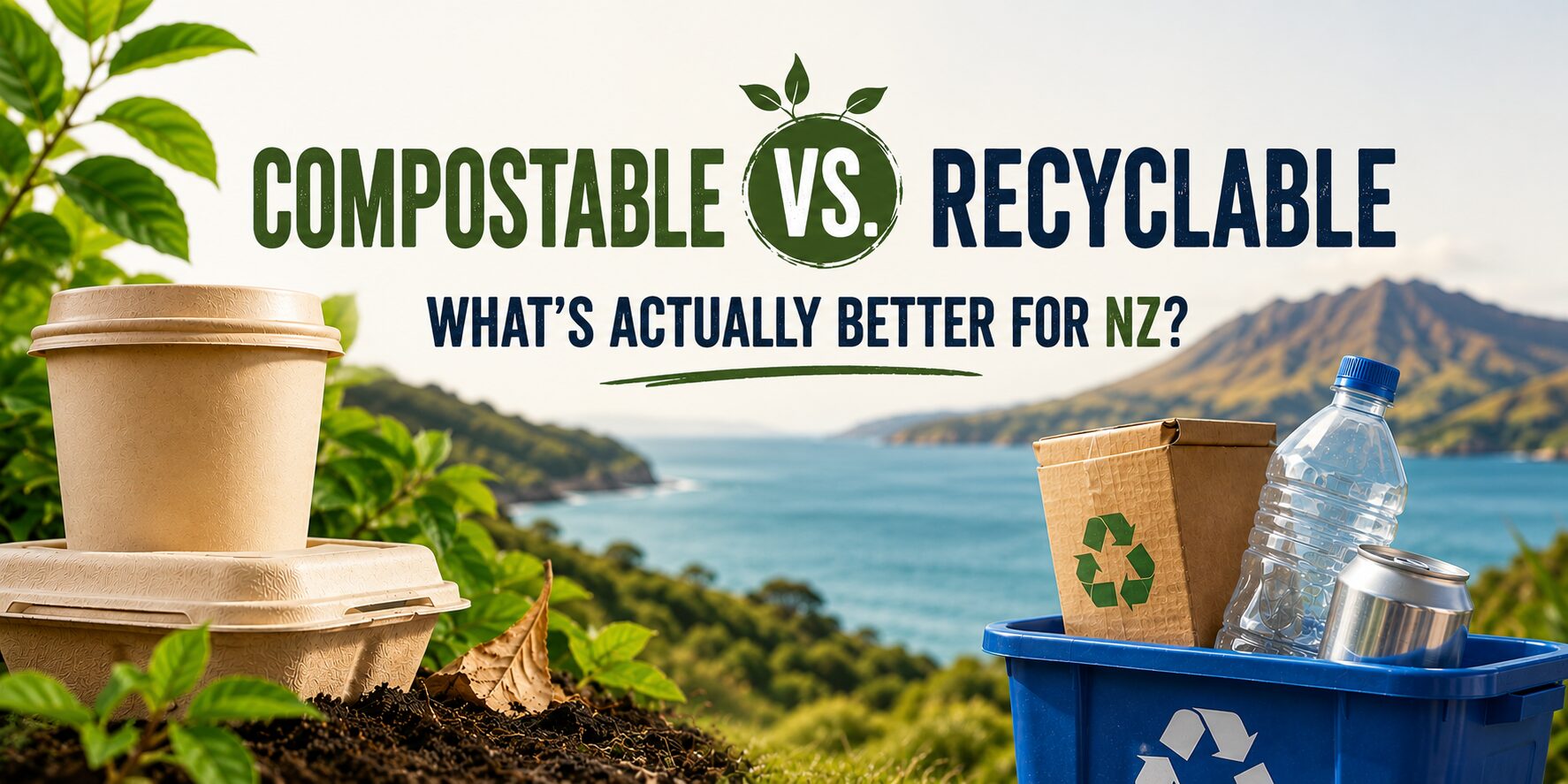
As sustainability moves from buzzword to business priority, more New Zealand companies are asking the same question: should we switch to compostable or recyclable packaging? Both sound like the right thing to do, but the honest answer is that it depends on where you are, what you’re packing, and what actually happens to the material after it leaves your customer’s hands.
Here’s a straight-talking guide to help NZ businesses make the right call.
Understanding the Difference
Recyclable packaging is collected through kerbside or drop-off programmes, processed at a Materials Recovery Facility (MRF), and turned into new materials. Common examples include PET plastic bottles, cardboard boxes, glass jars, and aluminium cans.
Compostable packaging is designed to break down into compost under the right conditions, either in an industrial composting facility or, for home-compostable certified products, in a well-maintained home compost system. Think certified compostable bags, sugarcane takeaway containers, and PLA-lined cups.
We’re all looking for a “better” alternative to single-use plastics, but “better” still varies.
The NZ Reality Check
New Zealand has a well-established kerbside recycling system, but it’s not perfect. Contamination rates are high, certain plastics (like soft films and black trays) still can’t be processed by most councils, and recyclables are increasingly assessed for their end-market value before being accepted.
Compostable packaging faces different challenges. Although they leave no trace when managed effectively, Life Cycle Assessments (LCAs) find that they have higher associated emissions due to intensive manufacturing and disposal. They hold very low to no nutritional value, meaning low demand from industrial composters. Home composting requires a great deal of maintenance to effectively break down home compostables, which research shows most of us don’t do. If compostables end up in landfill, they produce methane as they break down, which is arguably worse than a recyclable alternative. They also pose a high risk of contamination to the recycling stream, meaning otherwise recyclable material may end up in landfill.
The takeaway? Compostable packaging is only as good as the system around it.
So, Which Is Better?
Choose recyclable packaging if:
- Your customers are in urban areas with strong kerbside programmes
- The material (cardboard, aluminium, plastic) has a clear, proven recycling pathway in NZ
- You want a solution that works at scale right now
Choose compostable packaging if:
- You’re in the food service industry, and your packaging will be collected with food scraps
- You supply events, markets, or venues with access to commercial composting
- Your customers are engaged enough to correctly dispose of it
- You’re using certified home-compostable products for smaller consumer packaging
(NOTE: always check with your provider first – many industrial composters do not want packaging as there’s too high a risk of contamination (ie. non-compostables) and little or no nutritional value.)
The Honest Answer
There’s no universal winner. Recyclable courier bags made from recycled content are more impactful than compostable options. Equally, a compostable food tray recovered through a closed-loop system leaves no trace.
The best packaging decision is one that considers the full journey: emissions, material, use, collection, and end-of-life. Not just the label on the front.
At Bonson, we help NZ businesses find packaging that’s the most sustainable for their context, not just on paper. Get in touch with our team to explore what’s right for your product and your customers.
Ready to make a more informed packaging choice? Contact the Bonson team today.
More information:
About biodegradable and compostable plastics – Ministry for the Environment.
About compostable products – Ministry for the Environment.
A guide to biodegradable & compostable plastics products & packaging – WasteMINZ.
With thanks to Plastics NZ for help in compiling this article.
